Introduction
Overview
Implicit Outlook Integration extends intelliflo office functionality and user experience into Outlook by:
Providing financial advisors with contextual information and instant visibility into relevant intelliflo office information as they interact with their clients and leads via Outlook, enabling them to respond faster and more effectively.
Streamlining and automating data flow from Outlook – including emails, documents and appointments – into intelliflo office.
The new integration is feature-rich yet intuitive and easy to use, seamlessly blending itself into advisors’ daily use of Outlook as natural part of Outlook—no extra steps, no learning curve, just smarter work.
As an Outlook side-panel running alongside email inbox, it automatically identifies clients’ and leads’ emails and provides real-time insights as users read or compose messages. Users can browse, search and view intelliflo office directly from Outlook including clients, leads, service cases, plans and tasks.
Implicit facilitates the flow of input data from Outlook to intelliflo office by providing a variety of tools for both manual and automatic archiving of emails, ranging from a single-click to advanced multi-record options and rule-based auto-email archiving engine. These tools ensure that every client or lead interaction is accurately logged and easily traceable in intelliflo office.
The deployment and management of the Outlook add-in has been greatly simplified with centralized administration through Microsoft 365.
The Implicit integration saves time and enhances advisors’ productivity by allowing them to focus on what matters most – strengthening client relationships.
Key Features
Implicit for Outlook consists of two components:
Implicit for Outlook Add-in – This is a Microsoft 365 Add-in that is installed from Microsoft AppStore by either administrators on corporate accounts or by users on their individual accounts. It shows up as a side-panel in Outlook which becomes active when emails are selected. The side-panel shows relevant intelliflo office context for emails.
Key features include:
- Information about related clients, services cases, plans and tasks.
- Viewing intelliflo office records directly from Outlook.
- Multitude of tools to archive emails and attached documents from Outlook to intelliflo office, including ‘One-Click’ and ‘Advanced Archiving’.
- Robust browsing and searching capabilities across clients, leads and related records.
Implicit for Outlook Desktop App – A Windows taskbar application that works in conjunction with the Outlook add-in to augment its functionality with background processing. The desktop app is installed by users directly from the Outlook side-panel or by administrators using silent network-based software deployment tools.
Key features include:
- Synchronization of Outlook and intelliflo office calendars
- Robust browsing and searching capabilities across clients, leads and related records.
Trademarks
Implicit, the Implicit Logo, Implicit for Outlook, Implicit for Teams and combinations thereof are trademarks of Implicit Inc.
intelliflo, intelliflo office, intelliflo store are a registered trademark of Intelliflo limited.
Microsoft, Microsoft Office, Microsoft Outlook, Microsoft Teams, Microsoft 365, and Windows are registered trademarks of Microsoft Corporation.
Other product names used in this publication are for identification purposes only and may be trademarks of their respective companies.
Disclaimer
The contents of this document are provided in connection with Implicit Inc. (“IMPLICIT”) and Implicit for Outlook product. IMPLICIT makes no representations or warranties with respect to the accuracy or completeness of the contents of this publication and reserves the right to make changes to specifications and product descriptions at any time without notice. No license, whether express, implied, arising by estoppel, or otherwise, to any intellectual property rights are granted by this publication. Except as set forth in Implicit for Outlook License Agreement, IMPLICIT assumes no liability whatsoever, and disclaims any express or implied warranty, relating to its products including, but not limited to, the implied warranty of merchantability, fitness for a particular purpose, or infringement of any intellectual property right. IMPLICIT’s products are not designed, intended, authorized or warranted for use as components in applications intended to support or sustain life, or in any other application in which the failure of IMPLCIT’s product could create a situation where personal injury, death, or severe property or environmental damage may occur. IMPLICIT reserves the right to discontinue or make changes to its products at any time without notice.
Supported Platforms
- Microsoft 365
- Microsoft Outlook on Windows (Windows 11, Windows 10, Windows Server 2019, Windows Server 2016, Windows Server 2012 R2)
Admin Installation
Getting Started
The following installation instructions are intended for IT administrators. Please ensure that you are signed in as a Global Administrator or Exchange Administrator role on Microsoft 365.
There are two software components that you need to install:
Implicit for Outlook Add-in – This is a Microsoft 365 Add-in that should be installed via Microsoft 365 admin center and deployed to users’ Outlook.
Implicit Desktop App – This is a Windows desktop app that should be deployed to users’ desktop. It works in conjunction with the Outlook add-in to augment its capabilities and enable background processing for calendar sync and auto email archiving in intelliflo office.
To deploy Implicit for Outlook please follow these three steps:
- Deploying Implicit Desktop App to users’ desktops
- Granting Implicit Desktop App permissions to access Microsoft 365
- Installing Implicit for Outlook Add-in on Microsoft 365
Step 1: Deploying Implicit Desktop App to users’ desktops
Depending on which enterprise software deployment tools your organization is using, you can deploy Implicit Desktop App to users’ desktops in one of the following methods:
Method 1: Network Deployment of the Implicit Desktop App
If your organization utilizes software deployment tools such as Microsoft Endpoint Manager (Intune) or Microsoft System Center Configuration Manager (SCCM) or Active Directory Group Policy you can push MSI installers silently over the network.
Deploying .NET Desktop Runtime Version 8 – Prerequisite:
A prerequisite of the Implicit Desktop app is .NET 8 Desktop Runtime. Prior to pushing the Implicit Desktop App, please ensure that users have the latest .NET 8 desktop runtime version. Implicit Desktop app will work with any .NET 8 Desktop Runtime version higher than 8.0.18 (minimum version).
For the latest version, please see: https://dotnet.microsoft.com/en-us/download/dotnet/8.0/runtime/desktop
You can download .NET 8.0.18 Desktop Runtime (minimal version), using the following links:
Deploying Implicit Desktop App MSIs:
The Implicit Desktop App using MSI files can be downloaded using the following buttons:
64-bit MSI
Download 64-bit MSI
32-bit MSI
Download 32-bit MSI
Method 2: Deployment via Executable Installer
If you prefer to install the Desktop App directly on users’ desktops, or have users install it themselves, please make sure they have permissions to install the software on their desktops and refer them to Installing Implicit Desktop App on your desktop section below, for step-by-step instructions on how to download and install the executable installer.
Method 3: Deployment on Citrix, Remote Desktop (RDS) or VDI platforms
If you are using Citrix, Remote Desktop (RDS), or Azure Virtual Desktops infrastructure – Please contact us for the specific version of the software.
Step 2: Granting Implicit Desktop App permissions to access Microsoft 365
Implicit Desktop App needs permissions to access data on users’ 365 mailboxes. The required permissions are:
Access to users’ calendars – to sync with intelliflo office diary.
Access to users’ mail – to retrieve emails from users’ mailboxes and archive them in intelliflo office.
In order to prevent Microsoft 365 from prompting users to accept these permissions (which might be confusing to some users), Implicit made the provision for an administrator to grant the Desktop App these permissions on behalf of users. To approve, please click the following button:
Grant Permissions on Microsoft 365
Step 3: Microsoft 365 add-in Installation for Admins
This section outlines the step-by-step process for deploying Implicit for Outlook add-in organization-wide using the Microsoft 365 admin center.
Prerequisites
Before proceeding, ensure that you are signed in as a Global Administrator or Exchange Administrator in Microsoft 365.
Important Notice:
Please be aware that there is another Implicit Outlook add-in on Microsoft store called “Implicit for Outlook – SugarCRM/SuiteCRM” Please make sure not to install this add-in as it is for SugarCRM and SuiteCRM only and does not work with intelliflo office. To install the add-in for intelliflo office, please follow the instructions below.
Steps to Install the Implicit for Outlook Add-in
Step 1: Sign in to Microsoft 365 Admin Center
Sign in with your administrator credentials to Microsoft 365 Admin Center by going to https://admin.microsoft.com.
Step 2: Access Integrated Apps
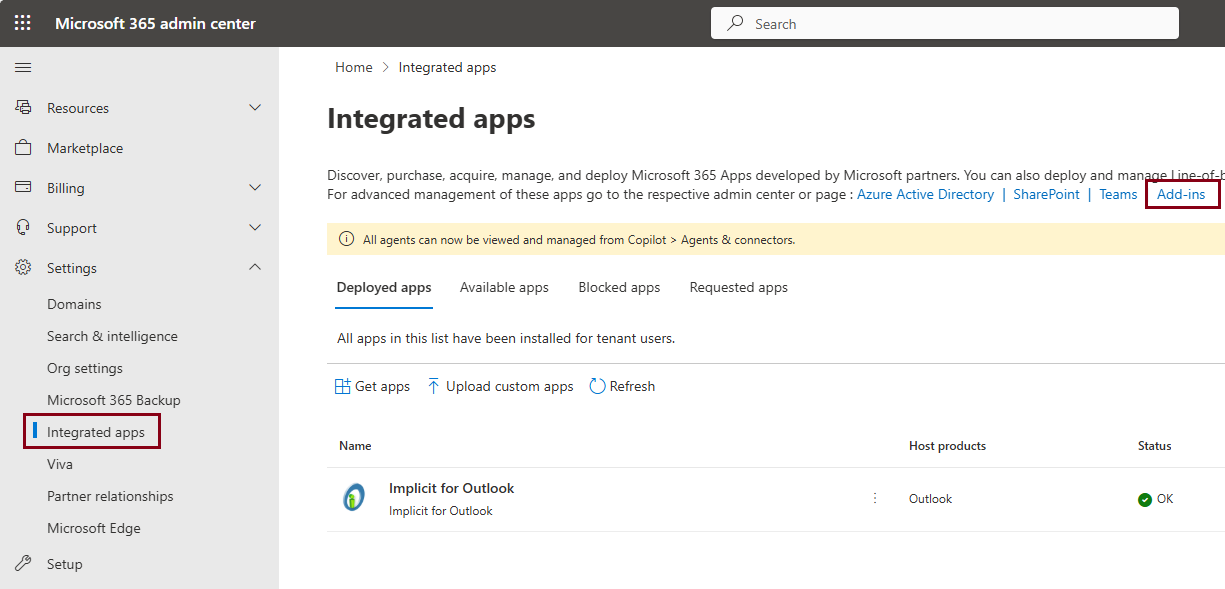
1. In the left-hand navigation panel, expand Settings and click Integrated apps.
2. Click ‘Add-Ins’
Step 3: Deploy Add-In
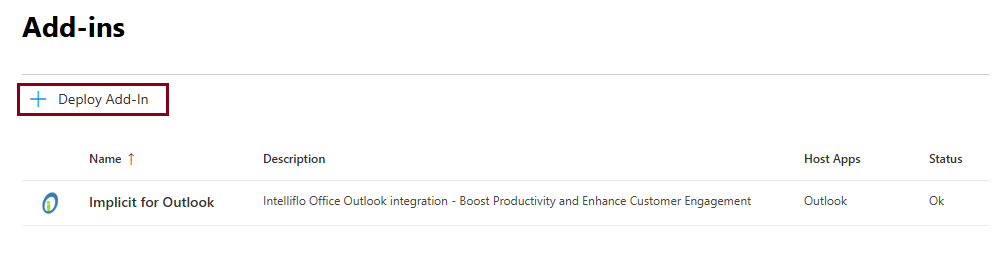
Click ‘+Deploy Add-In’:
Step 4: Deploy New Add-In
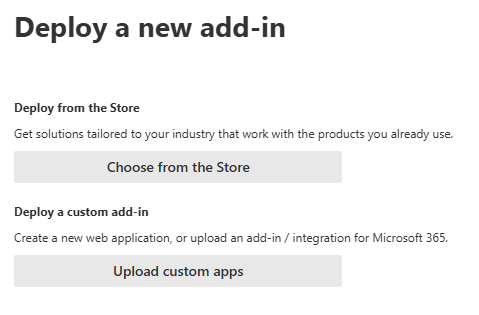
On the ‘Deploy New Add-In’ screen – select ‘Upload Custom Apps’
Next, select the method of specifying the add-in. As shown in the screenshot below, select ‘I have a URL for the manifest file’ and enter the following URL:
https://apps.outlook-integration.com/intelliflo/outlook/manifest.xml
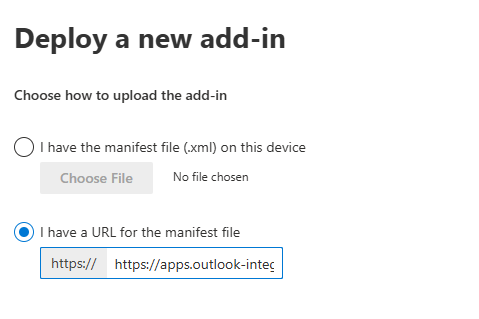
Important Note: Make sure to include “https://” in the URL that you enter.
Step 5: Select users and deployment method:
Select the users who would have access to the add-in and the deployment method:
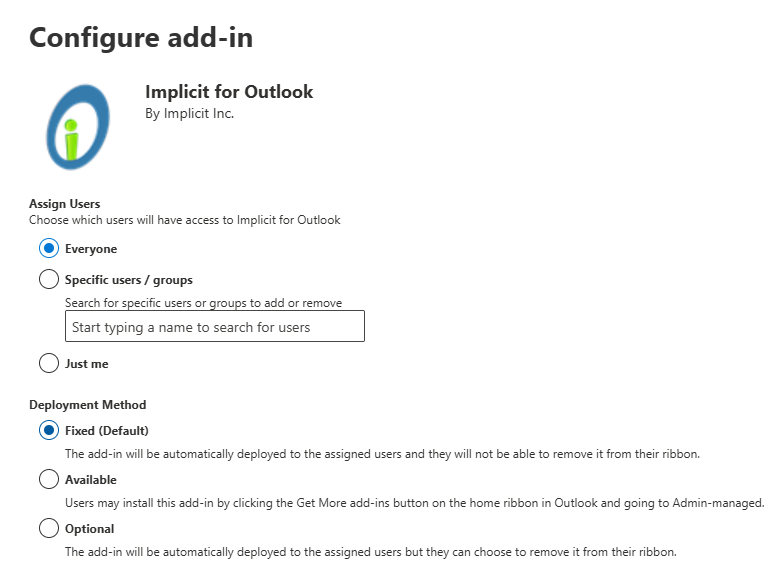
User selection:
You have an option to select the following:
- Everyone – All users under this Microsoft 365 tenant
- Specify Users / Groups – If you want to limit the deployment to only a group of users, we recommend creating a user group on Microsoft Azure that would include all the users that the intelliflo Outlook integration would be deployed to and selecting that group here. This way it’ll be easier for you to manage and add/remove users.
- Just Me – The add-in will be deployed to your account only.
Deployment Method
We recommend selecting the default ‘Fixed’ method.
Step 6: Final Step
Upon successfully deployment of the add-in on Microsoft 365, you’ll receive the following confirmation message that the add-in has been deployed.
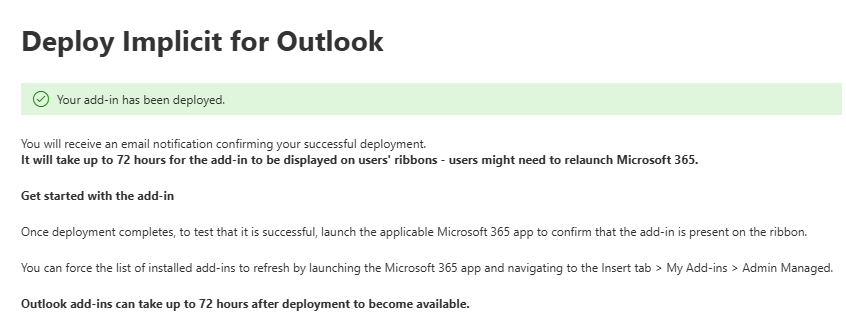
Important Note: As indicated in the message, it may take up to 72 hours for the add-in show up in users’ Outlook ribbon. Please notify users that they might need to exit and re-launch Outlook for the ‘Implicit for Outlook’ button to appear.
Confirming the add-in is accessible from Outlook
Sign in to Microsoft Outlook as a user. If you are already signed in, please sign out and sign in again.
When Implicit for Outlook has been deployed to Outlook, it will appear on the ribbon in Outlook as shown below:

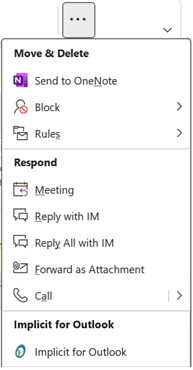
Note: Depending on the number of buttons you have configured on your Outlook ribbon, the Implicit button may also show up on the ‘More Commands’ (‘…’) button as show below:
User Installation
Installing Implicit Desktop App on your desktop
We recommend that the Implicit Desktop App is installed silently over the network by your IT admin. But if you need to install it yourself using the wizard-based installer, please download the installer by clicking on the button below and run it.
Download Implicit Desktop AppThe installer wizard will walk you through a set of screens:
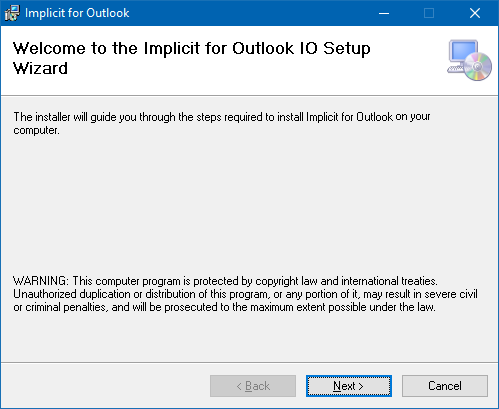
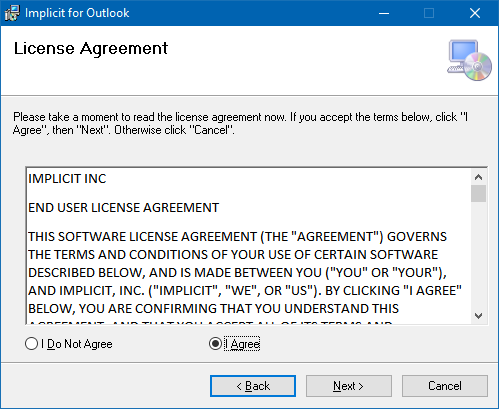
Click Next to continue. You will be prompted accept the Implicit EULA:
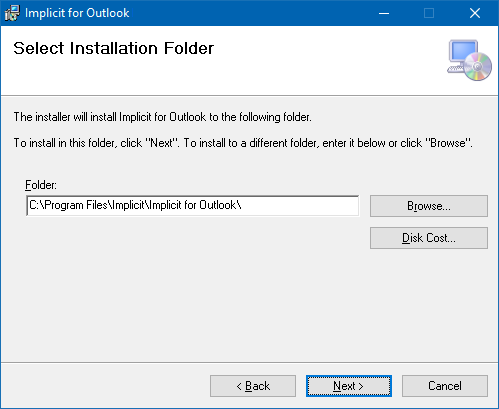
Next, you will be prompted to select the installation folder. By default, the installation folder will be set to: “\Program Files\Implicit\Implicit for Outlook”. Choose Browse to select a different folder. Then click ‘Next’.
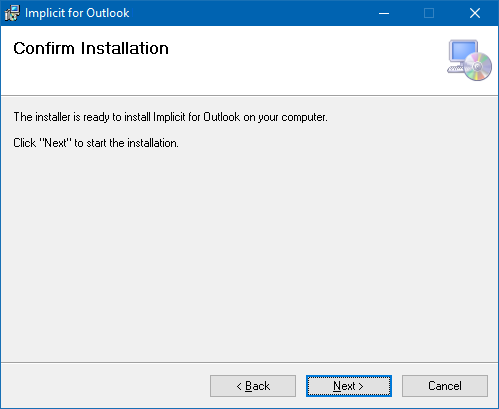
Next, the installer will be prompt you to confirm the installation and start copying the files.
Upon completion it will launch the configuration tool.
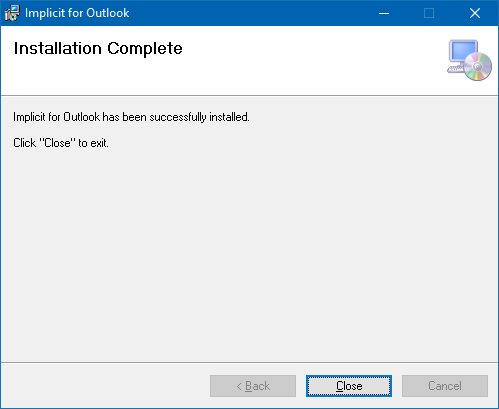
When the installation is done, the installer will launch Implicit Desktop App welcome screen where you will be prompted to sign-in to your Microsoft 365 and your intelliflo office accounts in order to link these two accounts. Please proceed to “Linking your Microsoft 365 and intelliflo office accounts” section of the User Guide.
Alternative Installation of Implicit Outlook Add-In
if you are part of an organization and your Microsoft 365 account is managed By IT through Microsoft 365 corporate account, the Implicit Outlook Add-in will be installed and deployed by your IT via Microsoft 365 Admin center. You can skip this section.
The following installation instructions are intended for individual users who do not have access to IT administrators and are planning to install Implicit for Outlook on their personal accounts.
Important Notice:
Please be aware that there is another Implicit Outlook add-in on Microsoft store called “Implicit for Outlook – SugarCRM/SuiteCRM” Please make sure not to install this add-in as it is for SugarCRM and SuiteCRM only and does not work with intelliflo office. To install the add-in for intelliflo office, please follow the instructions below.
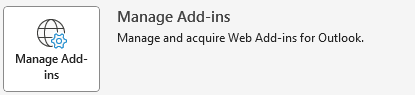
To install the Implicit for Outlook add-in from Outlook, select the File tab and click ‘Manage Add-Ins’
Outlook will launch a browser and prompt you to login to your Microsoft 365 account. It will present you with a list of available Outlook add-ins.
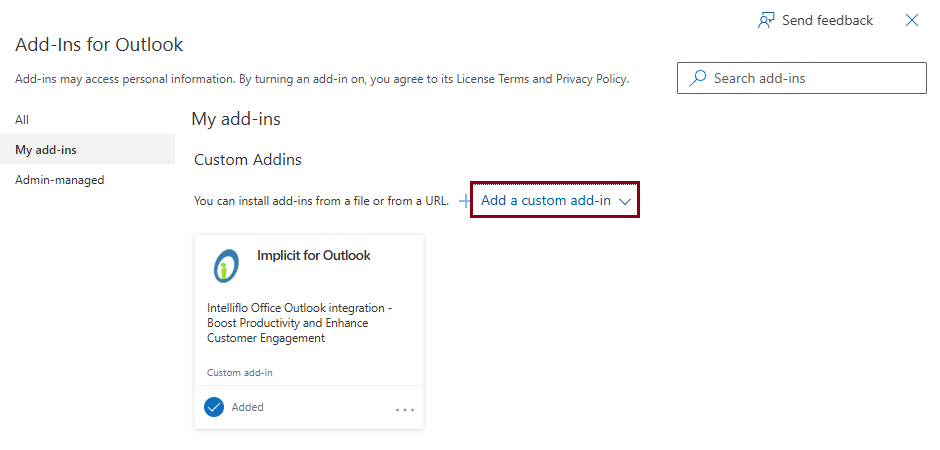
Click ‘Add a custom add-In’. You will be prompted to select and upload the add-in manifest file. The manifest file is a file that describes the functionality, capabilities and interfaces of the add-in.
Please use the following link to download the manifest file: https://apps.outlook-integration.com/intelliflo/outlook/manifest.xml
The manifest file will be downloaded into your downloads folder. Then upload this file to Microsoft 365.
The Implicit add-in will be added to your list of custom add-ins.
Confirming the add-in is accessible from Outlook
Important Note: It can take up to 72 hours for Microsoft 365 to refresh itself and for the Implicit for Outlook app to appear on the ribbon in Outlook and as an available App in a browser for Outlook online.
Sign in to Microsoft Outlook as a user. If you are already signed in, please sign out and sign in again.
When Implicit for Outlook has been deployed to Outlook, it will appear on the ribbon in Outlook as shown below:
Note: Depending on the number of buttons you have configured on your Outlook ribbon, the Implicit button may also show up on the ‘More Commands’ (‘…’) button as show below: